
You’ve mastered the types of Tit birds and memorized the field marks, but if your glass is blurry, that “lifer” is going to look like nothing more than a gray smudge. To truly see the chocolate-brown cap of a Boreal Chickadee or the fine “bridle” on a Titmouse, you need optics that can handle the grit of the trail.
As a “chaser” who has spent years sweating in the brush, I’ve put dozens of pairs to the test. Whether you are just starting out with our beginner birdwatching guides or you’re ready to invest in heirloom-quality gear, here are the top 5 binoculars that earn a spot in my pack.
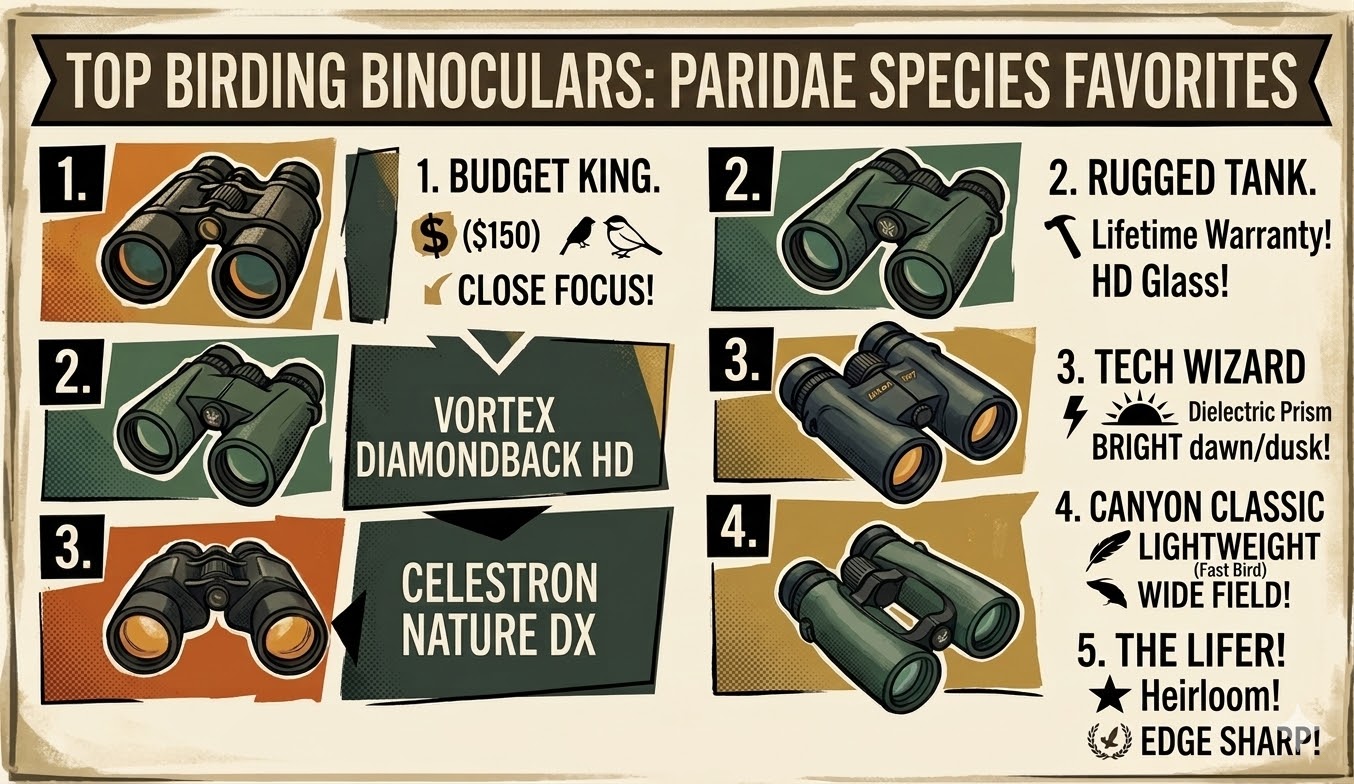
1. The Budget King: Celestron Nature DX 8×42
If you are new to the game, these are the gold standard for entry-level optics. They are waterproof, fog-proof, and offer a surprisingly close focus—perfect for when a curious Titmouse lands just a few feet away. For under $150, you won’t find better clarity.
2. The Rugged Mid-Range: Vortex Diamondback HD 8×42
This is the “Indiana Jones” of binoculars. They are built like a tank and come with a legendary lifetime warranty. The HD glass provides excellent color fidelity, making it much easier to spot rare species of Tit birds in low-light forest conditions.
3. The Tech-Heavy Pick: Nikon Monarch M7
For those who appreciate how technology is revolutionizing birding, the Monarch M7 offers dielectric high-reflective multilayer prism coatings. In plain English? They are incredibly bright. If you’re birding at dawn or dusk, these are your best friend.
4. The Lightweight Specialist: Zeiss Terra ED 8×42
When you’re trekking through canyons, every ounce matters. The Zeiss Terra EDs offer German engineering in a lightweight, compact frame. They provide a wide field of view, which is essential for tracking fast-moving Chickadees through thick canopy.
5. The Ultimate “Lifer” Glass: Swarovski EL 8.5×42
This is the “Holy Grail.” If you are serious about your birding life list, the Swarovski ELs offer unmatched edge-to-edge sharpness. You’ll see textures and colors you didn’t even know existed on a bird’s plumage. It’s an investment, but it’s the last pair you’ll ever buy.
Field Tip: Why 8×42?
You’ll notice most of these are 8×42. While 10x magnification sounds better, the 8x offers a wider field of view and a steadier image—crucial for following the erratic, acrobatic movements of the Paridae family.
What are you currently rocking in the field? Are you a “budget beast” or a “Swarovski seeker”? Let us know your gear setup in the comments!
Leave a Reply