
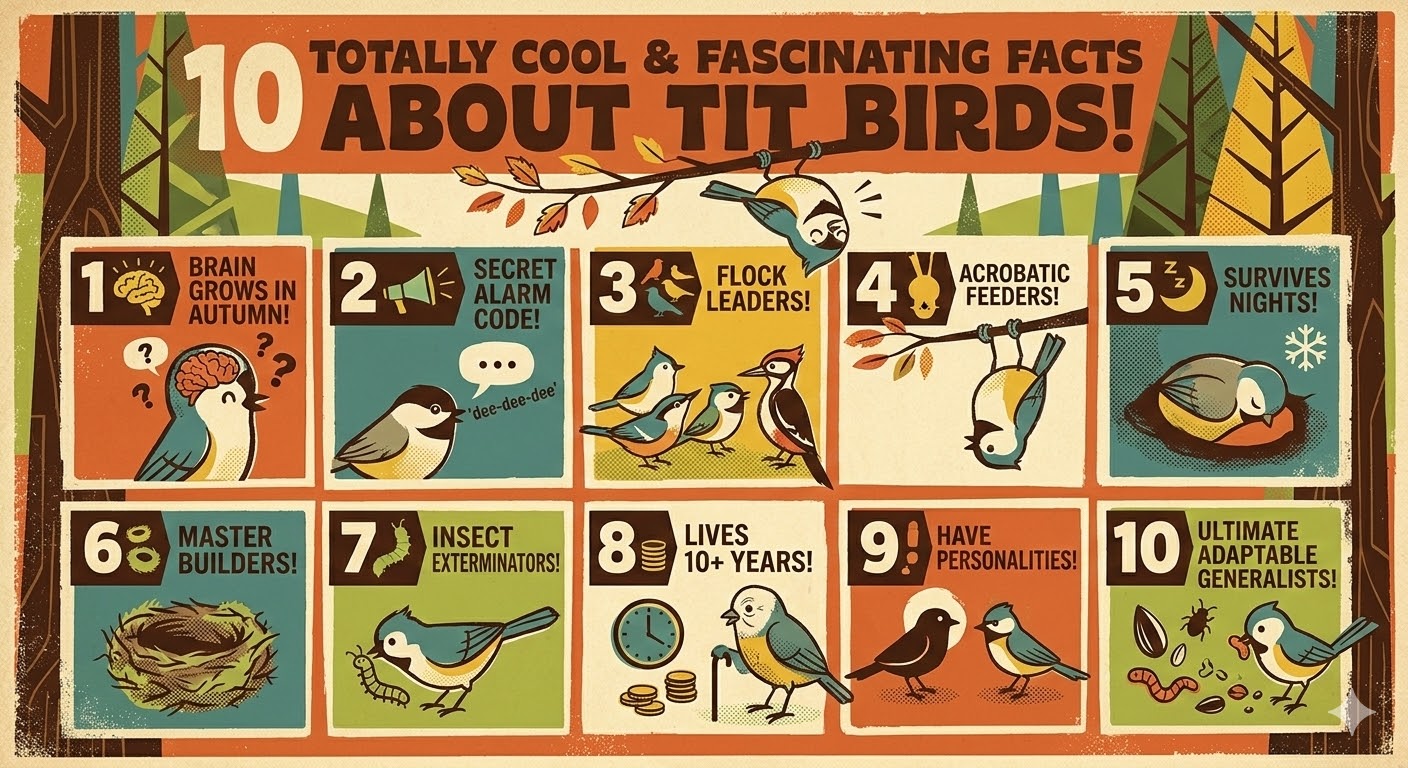
They are the acrobats of the bird feeder and the tiny titans of the North American woodland. Tit birds—including our beloved Chickadees and Titmice—might be small in stature, but they are giants when it comes to personality and biological brilliance.
Whether you are a seasoned “chaser” looking for rare species of Tit birds or just starting your journey with our beginner birdwatching resources, there is always something new to learn about the Paridae family. Put down the binoculars for a moment and dive into these ten incredible truths about the smartest little birds in your backyard.
1. They are Biological Memory Masters
Ever wonder how a bird the size of a golf ball remembers where it hid thousands of seeds? Tits and Chickadees actually grow new brain cells in the autumn. Their hippocampus—the part of the brain responsible for memory—increases in size by about 30% to help them recall their winter food caches. Researchers at the Zuckerman Institute have found that these birds function like tiny barcode scanners to index their hidden treasures.
2. The “Chick-a-dee” Call is a Complex Code
That familiar call isn’t just noise; it’s a sophisticated alarm system. The more “dee” notes at the end of the call, the higher the danger level. A “Chick-a-dee-dee-dee-dee” indicates a much more serious predator threat than a simple “Chick-a-dee.” This is just one example of how technology is revolutionizing bird identification, as AI can now help us decode these specific acoustic warnings.
3. They are Social Intellectuals
Tit birds often form “mixed-species foraging flocks.” They act as the leaders, with other birds like Nuthatches and Woodpeckers following them because Tits are the best at finding food and spotting danger early. They are essentially the neighborhood watch of the forest.
4. Acrobatic Eaters
Tits have incredibly strong legs and feet, allowing them to hang completely upside down to reach seeds or insects that other birds can’t get to. This acrobatic ability gives them a massive competitive advantage when food is scarce.
5. High-Speed Metabolism
To survive freezing winter nights, these tiny birds enter a state of regulated hypothermia called “torpor.” They lower their body temperature significantly at night to conserve energy, essentially “restarting” their internal heater every morning. You can read more about this fascinating survival tactic via the National Wildlife Federation.
6. Master Builders
Many Tit species are cavity nesters, but they don’t just find a hole and move in. They often line their nests with incredibly soft materials, including moss, feathers, and even fur plucked directly from living animals like squirrels or sleeping dogs!
7. They are Insect-Control Specialists
During the summer, a single pair of Tits can catch thousands of caterpillars to feed their brood. They are one of the most effective natural forms of pest control for your garden and local ecosystem, as noted by American Bird Conservancy.
8. Incredible Longevity
While many small birds have short lifespans, some Tits have been recorded living for over 10 years in the wild—a remarkable feat for a creature that weighs less than a handful of coins.
9. They Possess “Personality”
Ornithologists have discovered that individual Tits have distinct personalities. Some are “fast” and bold explorers, while others are “slow” and more cautious. These traits are often hereditary and help the species survive changing environments.
10. The Ultimate Generalists
One reason they are so successful across North America is their diet. They are true omnivores, pivoting from seeds and nuts in the winter to high-protein insects in the summer, making them one of the most adaptable families in the avian world.
What’s on Your Life List?
Learning these facts makes every visit to the feeder feel a little more like a front-row seat to a scientific marvel. These birds aren’t just cute; they are highly evolved survivalists with complex social lives and incredible intelligence.
Which of these facts surprised you the most? Do you have a “bold” or “cautious” Tit bird visiting your feeder? Let us know in the comments!
Leave a Reply